


If you live in Brooklyn, New York, and you are starting to feel that something has changed with Mom, Dad, Grandma, or an older neighbor, you are not being dramatic. Small changes can matter. Knowing the early signs of dementia elderly loved ones may show can help you act sooner, ask better questions, and create a safer daily routine. For families who need practical home support, Polish Home Services can be a local option to explore while you speak with a doctor and plan the next step.
Dementia is not one single disease. It is a group of symptoms that affect memory, thinking, judgment, communication, and daily functioning. Alzheimer’s disease is the most common cause, but there are other types too. That is why early concern should lead to a medical evaluation, not a quick label.
I know how easy it is to brush off early changes. A daughter may hear her father repeat the same story at dinner and think, He is just tired. A son may notice unpaid bills on the kitchen counter and feel skeptical because his mother always handled money perfectly. Then the pattern repeats. That is usually the moment when families feel surprised, worried, and ready for answers.
Table of Contents
Brooklyn Families: Alzheimer’s & Dementia (2026)
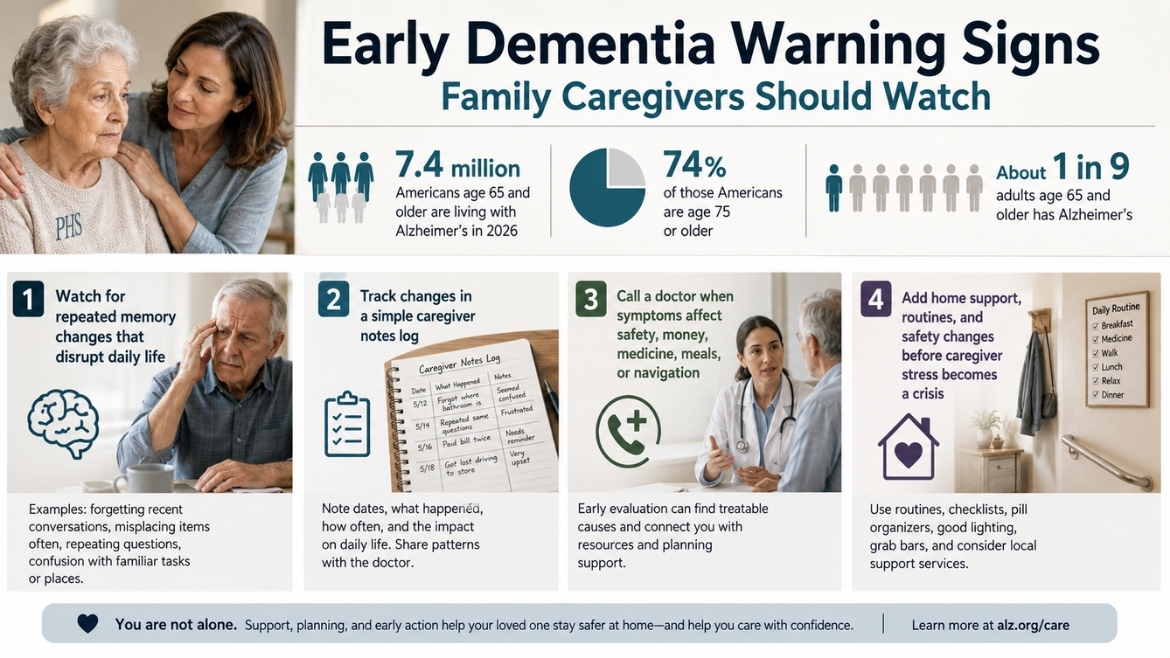
| Category | Impact & Risk Factor | Statistical Data | Source |
| National Prevalence | Total Americans aged 65+ living with Alzheimer’s | 7.4 million | Alzheimer’s Association |
| Age Concentration | Proportion of Alzheimer’s patients aged 75 or older | 74% | Alzheimer’s Association |
| Senior Population Risk | Overall likelihood of diagnosis for adults aged 65+ | 1 in 9 people | Alzheimer’s Association |
| Early-Senior Dementia Rate | Percentage of adults diagnosed between ages 65 and 74 | 1.7% | CDC Data |
| Late-Senior Dementia Rate | Percentage of adults diagnosed at age 85 and older | 13.1% | CDC Data |
| Benefits of Early Recognition | Critical family safety and health risks prevented | Unsafe driving Missed medication Wandering & getting lost Malnutrition / nutritional problems Severe caregiver burnout | Family & Clinical Care |
Early signs of dementia elderly family caregivers should notice
The first changes are often subtle. They may come and go at first, which makes them easy to dismiss. Look for patterns that show up more often, last longer, or interfere with daily life.
- Repeating the same question within a short period
- Forgetting recent conversations, appointments, or meals
- Trouble following a recipe, paying bills, or using familiar appliances
- Getting confused about the day, season, route, or location
- Losing items in unusual places, such as keys in the fridge
- Struggling to find words or follow a conversation
- Showing poor judgment with money, grooming, or safety
- Pulling away from friends, church, hobbies, or family gatherings
- Becoming more anxious, suspicious, irritable, or unusually quiet
- Having new trouble judging distance, steps, or visual contrast
The early signs of dementia elderly adults show are usually more than simple forgetfulness. They affect independence. For example, losing glasses is common. Accusing someone of stealing them every week, or placing them in the sugar jar and not being able to retrace steps, is different.
You may see the term dementia symptoms in seniors when reading about these changes online. You may also hear these called alzheimer’s early warning signs, especially when memory loss is the first concern. Either way, the key is to track what is new, frequent, and disruptive.
Normal aging or dementia concern
Aging can slow recall. Many older adults need a little more time to remember a name, learn a new phone setting, or recover a word during conversation. That alone does not mean dementia.
The difference is in daily impact. Normal aging may look like forgetting the date and remembering it later. A dementia concern may look like believing it is morning in the evening, missing a family event, then becoming confused or upset when corrected.
The early signs of dementia elderly caregivers notice may also overlap with depression, grief, sleep problems, thyroid issues, vitamin deficiency, infection, dehydration, pain, medication side effects, or hearing loss. This is why a doctor visit matters. Some causes of confusion can be treated, and families should not assume the worst without a careful check.
What to document before the doctor visit
A short written record is incredibly useful. Doctors often have limited visit time, and seniors may perform better in the office than they do at home. I have seen families feel relieved when they bring notes, because the conversation becomes calmer and more specific.
Track these details for two to four weeks if safety allows:
- What happened
- When it happened
- How often has it happened
- Whether it affected safety, money, meals, medicine, hygiene, or transportation
- Any recent illness, fall, new medicine, or major life stress
- What helped the person calm down or complete the task
Bring medication bottles, a list of supplements, and examples of changes. If your loved one is open to it, invite them into the process gently. Try saying, I noticed a few things that worry me, and I want us to check if anything medical is going on.
Safety signs that need faster action
Some situations should not wait for weeks of observation. Call a medical professional sooner if your loved one:
- Gets lost in a familiar area
- Leaves the stove on
- Forgets to eat or drink regularly
- Takes medicine twice or skips important doses
- Falls more often
- Shows sudden confusion, fever, weakness, or speech trouble
- Gives money to suspicious callers
- Wanders outside at night
- Becomes aggressive or extremely fearful
Sudden confusion can be a medical emergency, especially if it appears quickly. Infections, strokes, medication reactions, and dehydration can create serious changes in older adults. When symptoms are abrupt, severe, or paired with physical warning signs, seek urgent care.
How Brooklyn families can respond at home
For families in Brooklyn, New York, early signs of dementia elderly changes can be extra stressful because life is busy, apartments may have stairs, and adult children often juggle work, children, and long commutes. A simple plan can make a home safer without making your loved one feel controlled.
Start with small adjustments:
- Place a large clock and calendar in a visible spot
- Keep keys, wallet, phone, and glasses in one basket
- Use labeled pill organizers after checking with a pharmacist or nurse
- Set gentle phone reminders for meals and medicine
- Remove loose rugs and improve lighting
- Keep emergency contacts near the phone
- Simplify the kitchen and move risky items out of reach
- Create a calm daily routine for meals, bathing, rest, and activity
Try not to argue over every mistake. It is tempting, especially when you are tired. But correcting every detail can increase shame or frustration. A calm redirect often works better than a debate.
Where Polish Home Services may fit
Once early signs of dementia elderly changes are noticed, families often ask whether home support is enough. Polish Home Services describes in home elderly care, companionship, meal preparation, housekeeping, shopping, daily hygiene, diet monitoring, and long term support. The site also notes service roots in Williamsburg, Greenpoint, Manhattan, Queens, and Brooklyn, with trusted care since 1989.
That can be a strong fit when an older adult is mostly safe at home but needs daily structure, reminders, companionship, help with personal care, or support while family caregivers are working. You can also review their elderly care support when comparing local options.
Here is the honest limitation. Polish Home Services may not be the best standalone choice for a senior who needs hospital level monitoring, complex wound care, constant doctor supervision, or skilled medical treatment ordered under a clinical plan. In those situations, the family should speak with doctors about skilled nursing, home health, memory care, or a higher level of care.
Communication Strategy: How to Talk with Your Loved One
| Focus Area | Approach & Best Practice | Actionable Example / Goal |
| Understanding Fears | Recognize and respect that older adults often fear losing their independence more than the diagnosis itself. | Validate their feelings with respect; do not dismiss their desire for autonomy. |
| Timing the Conversation | Initiate the discussion during a calm, neutral, and unhurried moment. | Avoid bringing it up right after an argument, a mistake, or a stressful incident. |
| Using Gentle Language | Shift the focus from a definitive label to a supportive health partnership. | Instead of: “You have dementia.” Try: “I have noticed some changes, and I would feel better if we checked your health.” |
| Defining the Goal | Keep the conversation entirely practical. You are protecting dignity, safety, and quality of life. | Remember: You are not trying to win a debate or force them to admit there is a problem. |
| The “First Win” | Focus on small, manageable milestones rather than trying to figure everything out at once. | Aim simply to get an agreement for a routine primary care doctor’s appointment. |
What caregivers should avoid
Caregivers usually mean well, but stress can lead to choices that backfire.
- Do not ignore repeated changes because you are afraid of the answer
- Do not diagnose dementia on your own
- Do not shame your loved one for mistakes
- Do not take over everything too quickly if the person can still do some tasks safely
- Do not forget your own rest, meals, health visits, and emotional support
Caregiving can become exhausting before anyone admits it. Feeling frustrated does not make you a bad son, daughter, spouse, or neighbor. It means you need support too.
Final thoughts for family caregivers
The early signs of dementia elderly loved ones show can feel scary, but noticing them early is an act of care, not panic. Watch patterns, write things down, speak with a doctor, and build support around your loved one before the family reaches a breaking point. For Brooklyn families who want compassionate help at home while they plan the next step, Polish Home Services may be worth considering as part of a larger care plan.

