
Choosing care for an older parent in Brooklyn can feel heavy, especially when Mom or Dad keeps saying, “I just want to stay home.” If your family is comparing home care vs assisted living, start with your parent’s daily needs, safety risks, budget, and emotional comfort. Polish Home Services supports Brooklyn families with care at home, and you can learn more through Polish Home Services while you think through the right next step.
This is not only a practical decision. It is personal. I have seen families feel relieved after adding a few hours of help at home, and I have also seen families become surprised by how much calmer an older adult feels after moving into a community with meals, activities, and staff nearby. There is no one perfect answer. There is only one answer that fits your parent today and can adjust as needs change.
Table of Contents
The quick answer
The home care vs assisted living choice usually comes down to one question. Can your parent stay safe and well supported at home with the right help, or do they now need a supervised residential setting?
Home care is often best when your parent values routine, has a safe apartment or house, and needs help with bathing, dressing, meals, reminders, errands, light housekeeping, or companionship. Assisted living is often better when your parent needs a more structured setting, regular social activities, meals provided, and staff nearby during the day and night.
The decision also depends on family capacity. In Brooklyn, many adult children are juggling work, school schedules, subway commutes, parking headaches, and their own kids. It is easy to think, “We can handle it,” until missed meals, late medication reminders, and repeated calls start piling up.
| Care choice | Simple meaning | Best fit | Main concern |
| Home care | Support delivered in the parent’s own home | Higher-level residential care with more medical oversight | Moving can feel emotional and monthly fees can be high |
| Assisted living | The parent wants familiar surroundings and needs daily help | Parent needs more structure or feels isolated at home | Move can feel emotional and monthly fees can be high |
| Nursing home | Higher level residential care with more medical oversight | Parent needs extensive clinical support or complex care | Less independence and a more clinical environment |
Why this decision matters now
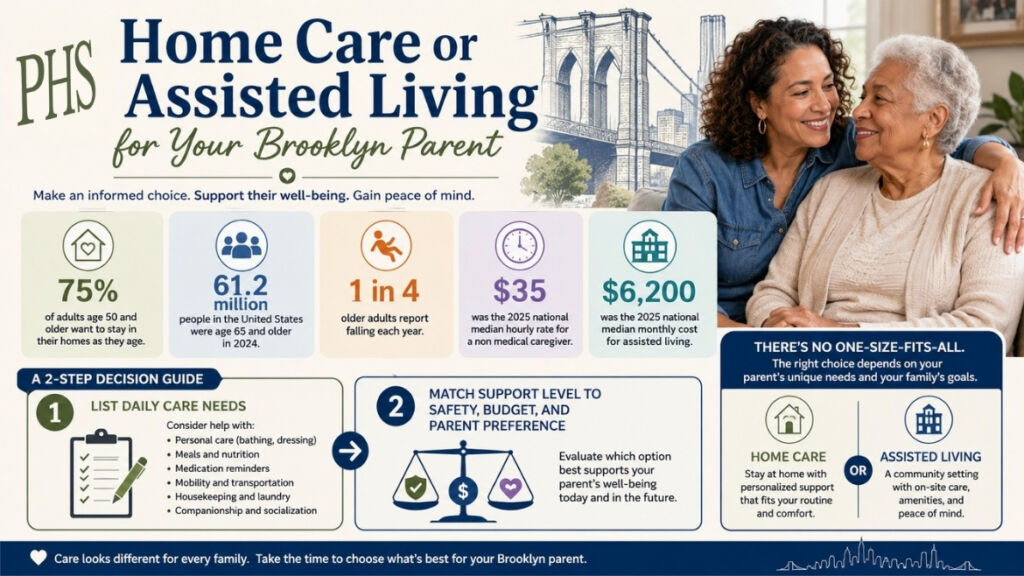
The home care vs assisted living conversation is becoming more common because America is aging quickly. The United States population age 65 and older reached 61.2 million in 2024 after rising 3.1 percent from 2023, according to the United States Census Bureau. That means more families are facing care decisions at the same time, including many in dense areas like Brooklyn.
Most older adults still want to remain at home. AARP reported in late 2024 that 75 percent of adults age 50 and older wanted to stay in their homes as they age, and 73 percent wanted to stay in their communities. I was honestly not surprised by that. A familiar kitchen, a favorite chair, a nearby church, a trusted store on the corner, and neighbors who wave hello can mean a lot.
At the same time, safety cannot be ignored. The CDC says more than 14 million older adults, or about 1 in 4, report falling every year. Falls are also the leading cause of injury for adults age 65 and older. That is why a parent’s preference should matter deeply, but it should not be the only factor.
What home care really looks like
In the home care vs assisted living debate, home care means support comes to your parent instead of your parent moving to support. A caregiver may help with personal care, meal preparation, laundry, light cleaning, mobility support, reminders, errands, and companionship. Some families begin with a few visits each week. Others need care every day.
For a Brooklyn parent in Greenpoint, Williamsburg, Bay Ridge, Borough Park, or Park Slope, that can be a major comfort. Your parents can keep their routines. They may continue seeing familiar neighbors. They can wake up in their own bed. For many families, that emotional stability is huge.
Polish Home Services says it provides personalized assistance to help seniors remain comfortable and independent in their own homes, with care available 24 hours a day and year-round. The company also notes that it has supported families with housework and senior care since 1989.
You can also explore its elderly care services if your parent mainly needs help with daily living, household support, and a steady caregiver presence at home.
When home care works best
Home care may fit well when:
- Your parent wants to stay in a familiar place
- They need help with bathing, dressing, meals, mobility, errands, or light chores
- They feel lonely but do not need a residential community yet
- Their home can be made safer with grab bars, better lighting, clear walkways, and fall prevention steps
- Family members can still check in and help manage appointments
- Your parent has cultural or language preferences that make matching with the right caregiver important
This is where home care vs assisted living gets very personal. Some parents feel embarrassed about needing help. Others relax once they realize the caregiver is not there to take over, but to help them keep control of their life.
When assisted living may be better
Assisted living may be the better option when your parent needs structure beyond what a few hours of home support can provide. In New York, adult care facilities provide long-term, non-medical residential services to adults who are substantially unable to live independently, according to the New York State Department of Health.
Assisted living can help when:
- Your parent is unsafe alone for long periods
- Meals are being missed often
- Medication routines are confusing
- Isolation is causing sadness or withdrawal
- The home has stairs, clutter, or layout issues that cannot be fixed easily
- Family caregivers are exhausted and cannot keep covering gaps
- Your parent enjoys group meals, activities, and social routines
I used to be skeptical when families said social activities were a deciding factor. Then I saw how much a regular lunch table, music hour, or exercise class could lift someone’s mood. It is not magic, but a connection can change the whole week for an older adult.
Cost is not as simple as it looks
Many families compare assisted living vs in-home care costs because the numbers can feel confusing. A monthly assisted living price may look high at first. Home care may look more flexible because you can choose fewer hours. But if your parent needs many hours each week, the total can rise quickly.
CareScout reported that the 2025 national median hourly rate for a non medical caregiver was 35 dollars. At 44 hours per week for 52 weeks, that equals 80,080 dollars per year. CareScout also reported that the national median cost for an assisted living community was $6,200 per month, or $74,400 per year.
Those figures are national medians, not a personal quote. Brooklyn pricing can vary based on care hours, apartment layout, caregiver skill needs, facility location, room type, and whether memory care or extra support is needed. The most useful approach is to compare your parents’ real weekly needs rather than only comparing headline monthly prices.
A practical cost example
Imagine your mother needs help 12 hours a week with bathing, meal prep, laundry, and errands. Home care may be more practical than moving. Now imagine she needs help 10 hours a day, feels unsafe overnight, and has frequent confusion. Assisted living, memory care, or a higher-level care setting may become more realistic.
That is why home care vs assisted living is not only a price comparison. It is a care needs comparison.
Aging in place vs nursing home
The phrase “aging in place” vs. “nursing home” often comes up when families are trying to avoid a move that feels too clinical. Aging in place means your parent remains at home with support. A nursing home is usually for people who need a higher level of ongoing medical and personal care.
Assisted living sits somewhere between those options. It offers housing, meals, supervision, and support, but it is not the same as a nursing home. If your parent needs daily skilled nursing, complex wound care, hospital-level monitoring, or intensive medical management, assisted living or non-medical home care may not be enough.
That is an important limitation to say clearly. Polish Home Services may be a strong fit for Brooklyn families who need practical in home support, companionship, personal care help, reminders, light household help, and a caregiver who understands the home setting. It is not the best fit by itself for a parent who needs constant clinical supervision, emergency medical care, or a facility based medical team.
How to decide without fighting with your parent
Care decisions can turn emotional fast. A parent may hear “assisted living” and think they are losing independence. An adult child may hear “I am fine” and think of the last fall, the spoiled food in the fridge, or the medication bottle that was still full.
Try this calm process:
- Ask what your parent fears most about changing care
- Walk through a normal day and write down where help is needed
- Check the home for fall risks, poor lighting, stairs, bathroom hazards, and kitchen safety
- Review missed meals, missed appointments, confusion, hygiene changes, and loneliness
- Compare three care levels: a few hours of home care, daily home care, and assisted living
- Talk with a physician or care professional if medical issues are part of the picture
- Choose a trial period, when possible, because real life gives better answers than guesses
NY Connects can also help New York families find free, objective information about long term services and supports, including options that help people remain independent in the home or another residential setting.
Comparing Polish Home Services with other options
The table below is not about saying one choice is always better. It shows how different options fit different family needs in Brooklyn.
| Option | Best for | Strength | Possible limitation |
| Polish Home Services | Brooklyn seniors who want help at home with daily routines, companionship, personal care, meals, reminders, and light household support | Helps parents remain in familiar surroundings with personalized support | Not a stand alone substitute for hospital care, skilled nursing care, or a residential medical setting |
| Assisted living community | Seniors who need meals, social activities, supervision, and a more structured daily setting | Built in social life and staff presence | Requires a move and may feel emotionally difficult |
| Nursing home | Seniors with complex medical needs or high personal care needs | Built-in social life and staff presence | Less independence and a more institutional feel |
Signs your parent may need more help
The home care vs assisted living decision becomes clearer when you look at patterns rather than single incidents. One messy kitchen does not always mean a crisis. A pattern of missed meals, weight loss, confusion, falls, or unsafe cooking is more serious.
Look for:
- Repeated falls or near falls
- Trouble bathing or dressing
- Spoiled food or little food at home
- Unpaid bills or missed appointments
- New loneliness or withdrawal
- Poor medication routine
- Caregiver burnout in the family
- Wandering, unsafe stove use, or major confusion
If you feel relieved when someone else notices the same signs, that is normal. Many adult children quietly worry for months before asking for help. You are not overreacting by taking safety seriously.
Questions to ask before choosing
Before choosing care, ask these questions:
- Does my parent need help every day or only a few times a week?
- Are nights safe?
- Can the bathroom, bedroom, and kitchen be made safer?
- Does my parent remember meals and medications?
- Is loneliness a major issue?
- Can family support continue without burnout?
- Does my parent want cultural familiarity, language comfort, or a caregiver who understands Brooklyn family life?
- What monthly budget is realistic for at least 6 to 12 months?
- What would make us change the plan later?
A good care plan should not trap your family. It should give you a starting point and a way to adjust.
Final thoughts for Brooklyn families
There is no shame in choosing home care, and there is no shame in choosing assisted living. The right answer is the one that protects your parents’ safety, dignity, and emotional comfort. For many Brooklyn families, home care vs assisted living starts with a small trial of support at home. For others, assisted living is the kinder choice because it reduces isolation and gives structure.
If your parent can still live safely at home with daily support, Polish Home Services may be worth considering as part of your care plan. If your parent needs a higher level of clinical supervision or is unsafe even with regular help, a residential care setting may be the wiser path. To explore local support and ask practical questions, visit Polish Home Services and take the next step with a calm, informed conversation.