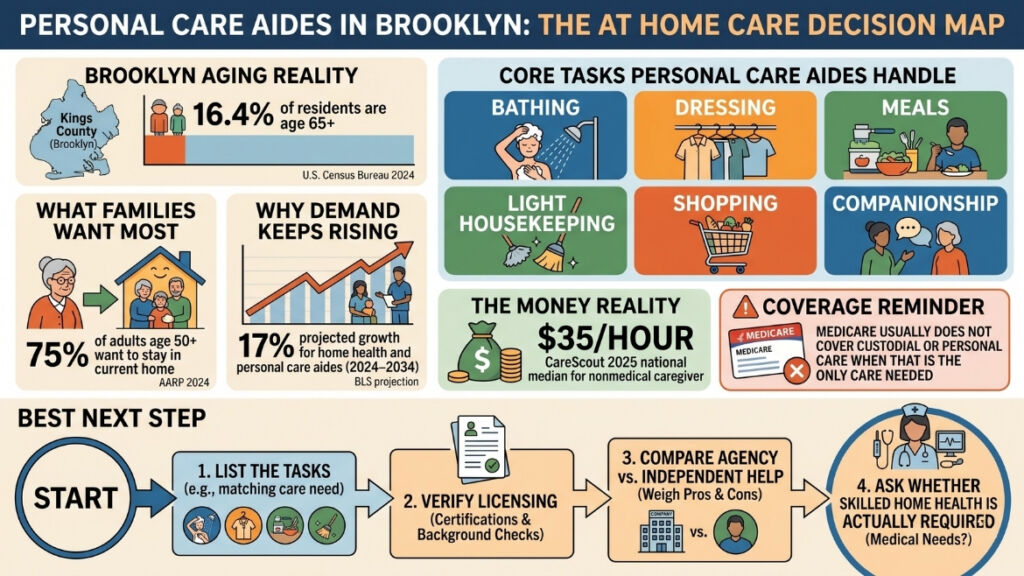
Personal care aides are becoming one of the first things families in Brooklyn search for when a parent starts needing help with bathing, dressing, meals, or safe movement at home. That shift fits what the data shows. AARP reported in 2024 that 75 percent of adults age 50 plus want to stay in their current home as long as possible, and the U.S. Census Bureau reports that 16.4 percent of residents in Kings County are age 65 or older.
Sometimes the change shows up in tiny ways. A shower that used to take ten minutes turns into a careful balancing act. Grocery bags stay near the door because carrying them inside suddenly feels like too much. If you are trying to figure out whether you need a personal care assistant, personal home care services, or a more clinical option, this guide will help you sort that out without the usual confusion.
Table of Contents
What personal care aides actually do
The terms personal care aides, personal care assistant, and PCA often overlap in everyday search language. At the practical level, the job is hands on support with daily living. The Centers for Medicare & Medicaid Services explains that personal care services help eligible people stay in their own homes and communities, while the U.S. Bureau of Labor Statistics says home health and personal care aides help with daily living and often support older adults who need assistance.
That is why a personal care assistant for elderly support is usually about routine help, comfort, and safety. Home health aides and personal care aides can overlap, but BLS notes that some home health aides may work under the direction of a nurse or other health professional and may be allowed to give medication or check vital signs. One point catches families off guard: Medicare says it does not pay for custodial or personal care when that is the only care someone needs. Honestly, that surprises people all the time.
| Quick Fact | What it Usually Means at Home |
| Personal care aide focus | Help with bathing, dressing, grooming, meals, walking, light housekeeping, and routine support. |
| Common search terms | Personal care assistant, in-home personal care assistant, home personal care assistant, and PCA personal care assistant often point to similar day-to-day help. |
| Where families get confused | Home health personal care sounds similar, but skilled home health follows different medical and coverage rules. |
| Coverage reality | Medicare usually is not the payer when personal care is the only need. |
| Best fit | At-home personal care works best when someone can stay safer and more comfortable at home with steady support. |
These quick facts summarize definitions and coverage rules described by CMS, Medicare, and BLS.
Why Brooklyn families are paying attention now
When people type personal care aides Brooklyn or personal care aides near me into a search bar, they are usually trying to solve a real problem, not casually browse options. The numbers explain the urgency. AARP found in 2024 that 75 percent of adults age 50 plus want to remain in their current home. BLS projects 17 percent growth for home health and personal care aides from 2024 to 2034, with about 765,800 openings each year on average. That kind of demand says this is no fringe service anymore.
Cost is part of the story, too. CareScout reported in its 2025 cost data that the national median hourly rate for a nonmedical caregiver reached $35. It is hard not to be impressed by how fast a small amount of help can turn into a serious budget conversation.
A lot of families wait longer than they mean to. If you have ever stood outside a bathroom door listening a little too closely, or noticed untouched groceries sitting in the kitchen at the end of the day, you already know the moment I mean. The calmer move is usually to start personal home care assistance before a predictable struggle turns into a crisis at home.
- Bathing or dressing is being skipped because it feels tiring, awkward, or unsafe.
- Meal prep, laundry, shopping, or medication reminders keep slipping.
- A relative is quietly doing more and more unpaid care and getting worn down.
- Walking, transfers, and stairs look less steady than they did a few months ago.
- Loneliness is becoming part of the problem, not just mobility or hygiene.
Those signs line up with the daily living support described by BLS and the stay at home preference highlighted by AARP.
How to choose the right personal care assistant or agency
The smartest search is not just a personal care assistant agency near me. It is a more specific question: do you need hourly personal care assistant services, a private personal care assistant for consistency, an independent personal care assistant you manage more directly, or a live in personal care assistant because both mornings and evenings have become hard?
Start with the actual tasks, not the label. Write down what help is needed this week. Bathing. Dressing. Bathroom support. Meal prep. Walking. Shopping. Cleanup. Companionship. Then ask how often it happens and who is doing it now. That simple list makes it much easier to match the need to the right level of personal home care, personal home care agency support, or PCA home care.
Next, check whether the provider is regulated. State guidance says organizations must be licensed or certified as home care agencies, and the state provides Home Care Agency Profiles so families can review regulated agencies. After that, ask who supervises care, what happens if the regular aide calls out, whether you can shift from short visits to longer coverage, and whether the agency can support a senior personal care assistant or live in arrangement if needs grow.
It also helps to confirm payment reality early. Medicare covers certain home health services when skilled care is involved, but Medicare also says custodial or personal care is not covered when that is the only care someone needs. If you are unsure where your case falls, the New York State Office for the Aging says NY Connects offers free, unbiased information, and local offices can connect older adults and caregivers to programs and services. That is a real relief when a family is trying to separate personal home care from skilled home health.
Be a little skeptical of any provider that answers every question with a vague promise. Good agencies should be able to explain the care plan in plain language. A solid personal care assistant agency near me answer should sound specific, calm, and organized, not flashy.
How Polish Home Services compares to traditional options
Polish Home Services presents itself as a Brooklyn based provider focused on in home support for older adults. On its website, the company says it has served families since 1989, offers live in and live out care, and provides help with companionship, meals, housekeeping, shopping, long term care, daily hygiene, and personal care support. The site also says caregivers are trained, background checked, and available around the clock.
| Quick Fact | What it Usually Means at Home |
| Personal care aide focus | Help with bathing, dressing, grooming, meals, walking, light housekeeping, and routine support. |
| Common search terms | Personal care assistant, in-home personal care assistant, home personal care assistant, and PCA personal care assistant often point to similar day-to-day help. |
| Where families get confused | Home health personal care sounds similar, but skilled home health follows different medical and coverage rules. |
| Coverage reality | Medicare usually is not the payer when personal care is the only need. |
| Best fit | At-home personal care works best when someone can stay safer and more comfortable at home with steady support. |
This comparison combines Polish Home Services’ stated services with Medicare and CMS distinctions between personal care and skilled home health, plus the state licensing framework.
Here is the honest read. Polish Home Services appears best suited for families who want personal home care services, elderly personal care, household help, or a more family style in home presence. It may feel especially appealing if language or cultural familiarity matters. If the person at home mainly needs ongoing skilled nursing, therapy, or another clinical service ordered through Medicare, a Medicare certified home health provider is usually the better fit for that part of the plan.
FAQs
Q1. What is the difference between a personal care assistant and a home health aide
A personal care assistant usually focuses on day to day help such as bathing, dressing, meals, walking, and household routines. BLS notes that some home health aides may also work under nurse or practitioner direction and may be allowed to give medication or check vital signs, which pushes that role closer to clinical support.
Q2. Are personal care aides near me covered by Medicare
Usually not when personal care is the only need. Medicare says it does not pay for custodial or personal care alone, though it may cover part time home health aide care when skilled nursing or therapy is also part of the plan.
Q3. Can a live in personal care assistant help with bathing and meals
Often yes, depending on the care plan and provider. BLS describes home health and personal care aides as helping with bathing, dressing, housekeeping, groceries, appointments, transportation, and preparing meals.
Q4. How do I find a personal care assistant agency near me in Brooklyn
Start by checking whether the provider is licensed or certified in the state, then use NY Connects or local aging offices if you need help sorting programs and options. After that, ask for a written outline of tasks, hours, backup coverage, and whether the service is personal care or skilled home health.
Q5. Where does Polish Home Services seem to fit best
Based on its website, Polish Home Services fits best when a family wants personal care aides, companionship, daily hygiene help, meals, shopping, housekeeping, long term support, or live in and live out care at home. If the main need is skilled nursing or therapy under a medical plan, it should be considered alongside, not instead of, a Medicare certified home health option.
Conclusion
If your family is weighing personal care aides, the clearest next step is to stop searching in generalities and start naming the exact routines that need help. Once you know whether the need is bathing, meals, mobility, companionship, overnight presence, or a fuller live in setup, the right path gets much easier to see.
For Brooklyn families, the practical order is simple. First, write the weekly task list. Second, decide whether you need hourly visits, a private personal care assistant, or a personal home care agency with backup coverage. Third, confirm whether the case is ordinary at home personal care or a medically driven home health situation. If you want a local option, Polish Home Services is one provider to review based on its Brooklyn location, long stated experience, and broad in home support on its site. If you want neutral guidance before choosing anyone, NY Connects is a smart place to start.
Caring hands, trusted hearts: contact Polish Home Services for personalized elderly care today.